www.strongtie.com


High Wind Framing Connection Guide

Learn more about High Wind & Hurricane Safety
___

See additional design examples below
___


The High Wind Framing Connection Guide is being updated and will be available later this year.
Sign up for our newsletter for the latest information.

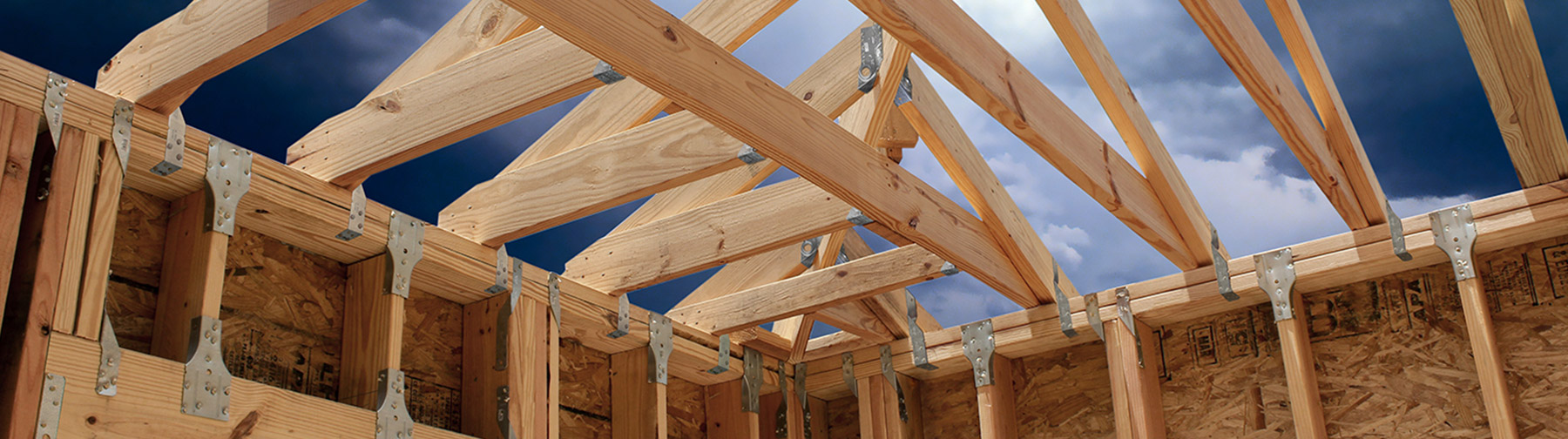
Building codes require structures to be designed with a system of connections that provide a continuous load path capable of transferring forces through the framing members to the foundation. In regions of the country prone to high wind events, this method of construction is critical to the safety and welfare of the public.

Designing Homes for High Wind
Homes in high wind regions are often designed by professional structural engineers who carefully detail the connections required between framing members to ensure that the wind forces are safely transferred through the structure. The building code also offers prescriptive design guidelines that provide instructions for builders and detail the way the structure should be built. The International Residential Code (IRC) provides prescriptive requirements for homes built in low wind regions defined as having a design wind speed less than 110 mph for the 2003 IRC or less than 100 mph for the 2006 IRC. For higher wind speeds, the IRC refers builders to the AF&PA Wood Frame Construction Manual (WFCM) which covers construction methods for winds speeds up to 150 mph.

New Reference Guide
Simpson Strong-Tie has created a reference guide, entitled High Wind Framing Connection Guide, to help builders and contractors build to the higher wind speed standards. The guide is intended to be used as a companion to the WFCM and provides a schedule of recommended connectors that meet or exceed tabulated load requirements. The tables define the minimum sizes of members in the connection and the connector and/or fasteners required for the given wind speeds. The tables do not reference all framing conditions, but rather feature the most common sizes and spacing for framing members in residential construction. Tables and graphics are provided in an attempt to help users understand how the connections are to be made.

Designs provided by a professional engineer may differ from those outlined in this guide as the engineer can compute the design loads on the actual geometry of the building versus the assumptions made in the WFCM and this guide.


    Additional Design Examples:
 
 
Download Example 1 (PDF)
 

Example 1

The High Wind Framing Connection Guide design example 1 includes elevations and floor plans of a single story structure in the 130 mph wind speed zone with detailed uplift and lateral connections using Simpson Strong-Tie's new High Wind Framing Connection Guide (HWFCG). The drawings are intended to be used as an example and aid for learning how to use and apply the HWFCG and the 2001 edition of AF&PA's Wood Frame Construction Manual (WFCM) in high wind applications.

Design example 1 does not provide a complete building design. The user is responsible for designing or consulting a professional designer to address all other structural elements not included in this design example. Reference the WFCM and all other applicable building codes for all other structural elements, connections fastening schedules and member designs not included in these sheets.

Original floor plans and elevations courtesy of the CADD Technology Department at Lee College, Baytown Texas

 
Download Example 2 (PDF)
 

Example 2

The High Wind Framing Connection Guide design example 2 includes elevations and floor plans of a two story structure in the 120 mph wind speed zone with detailed uplift and lateral connections using Simpson Strong-Tie's High Wind Framing Connection Guide (HWFCG). The drawings are intended to be used as an example and aid for learning how to use and apply the T-HWFCG06 and the 2001 edition of AF&PA's Wood Frame Construction Manual (WFCM) in high wind applications.

Design example 2 does not provide a complete building design. The user is responsible for designing or consulting a professional designer to address all other structural elements not included in this design example. Reference the WFCM and all other applicable building codes for all other structural elements, connections fastening schedules and member designs not included in these sheets.

 
Printed from
© 2013 Simpson Strong-Tie Company Inc.